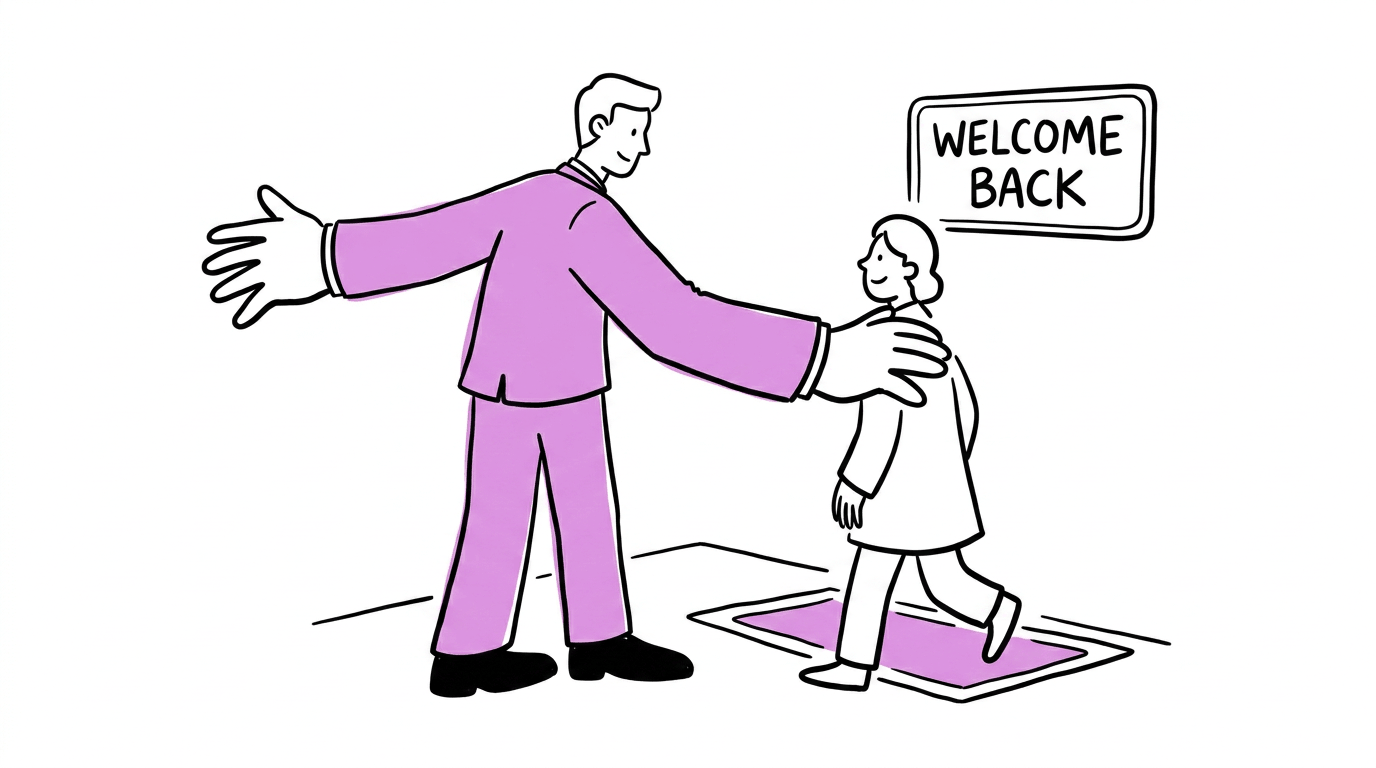

There’s a specific kind of quiet in your customer base that’s easy to ignore. Not the dramatic churn — the angry cancellation, the negative review, the refund request. The quiet kind. The customers who just stopped. Stopped opening emails, stopped logging in, stopped purchasing. They didn’t leave loudly. They drifted.
These are your lapsed customers, and they represent one of the most underutilised assets in lifecycle marketing. They already know your product. They already had a reason to sign up or buy. They cost a fraction of a new acquisition to recover — if you approach it correctly.
The mistake most teams make is treating win-back as an afterthought: a “We miss you” email sent at 60 days to everyone who hasn’t opened anything recently. That approach doesn’t just underperform. It can actively damage deliverability and accelerate the disengagement you’re trying to reverse.
A real win-back program is a structured, segmented, sequenced effort. Here’s how to build one.
First: understand why they went quiet
Seth Godin writes that “the cost of being wrong is less than the cost of doing nothing.” In win-back, the instinct to do something — anything — is understandable. But sending the wrong message to the wrong lapsed customer at the wrong time can permanently close a door that might have opened on its own.
Before you build your sequences, invest time in understanding the reasons customers go quiet. In most businesses, lapsed customers fall into a handful of categories:
Lost the habit. They used the product or bought from you regularly, then something disrupted the pattern — a life change, a busy period, a competing priority. They don’t have a negative feeling about you. They just got distracted.
Hit a friction point. Something broke, or confused them, or didn’t work the way they expected. They didn’t cancel; they just stopped trying. These customers are recoverable, but they need acknowledgment of the problem, not a generic re-engagement push.
Found an alternative. A competitor solved their problem. They may have moved on permanently, or they may be willing to come back if you can show them what’s changed.
Outgrew the need. The problem your product solved was temporary or situational. They’re not unhappy — they just don’t have a use case anymore.
Your win-back messaging should differ meaningfully based on which category the lapsed customer is in. The problem is you often can’t know for certain — which is why segmentation by behavior, rather than assumptions, is the starting point.
Segment before you sequence
The most effective win-back programs don’t treat all lapsed customers the same. They segment by recency, depth of previous engagement, and last known behavior.
Recency tiers are the foundation. A customer who went quiet 30 days ago is in a very different place psychologically than one who hasn’t engaged in six months. The further out you go, the lower the recovery rate — but also the lower the risk of bothering someone who was just about to come back on their own.
A practical three-tier structure:
- Early lapse (30–60 days): Still warm. Recovery rates are highest here. One or two targeted messages focused on what they might have missed.
- Mid lapse (60–120 days): Cooling. Needs a stronger hook — a new feature, a meaningful offer, or a direct question about what went wrong.
- Deep lapse (120+ days): Cold. Lower conversion rates, but high-value customers in this tier are worth a final attempt before suppression.
Engagement depth adds an important layer. A customer who used your product daily for six months before going quiet is a very different win-back candidate than someone who made one purchase and disappeared. High past engagement means high potential for recovery. It also means they likely went quiet for a specific reason — and finding it matters.
At HelloPrint, where we managed customers across multiple European markets with very different purchase cycles, this kind of segmentation made a dramatic difference. A customer in a seasonal buying window needed a completely different re-engagement approach than a customer who’d been consistently active and then stopped abruptly.
The win-back sequence
Once you’ve segmented, here’s a sequence structure that consistently outperforms the single “We miss you” email.
Message 1 — The check-in (send at lapse threshold)
No offer. No pressure. A genuine, low-friction message that acknowledges their absence and opens a door.
The frame: “We noticed you haven’t [logged in / purchased / opened anything] in a while — wanted to check in.”
This works because it doesn’t feel like marketing. It feels like someone noticed. Keep it short. One sentence about what’s new, one question about whether there’s something they need help with, one clear CTA. Nothing more.
“The aim of marketing is to know and understand the customer so well the product or service fits him and sells itself.”
— Peter Drucker
Message 1 is about listening before selling.
Message 2 — The value reminder (5–7 days later, non-openers)
Now you lead with value. Remind them specifically of what they were getting before they went quiet — their last key action, a result they achieved, or a feature they used most. Make it personal, not generic.
Avoid: “Here are all the things our product can do.” Instead: “The last time you [action], you [result/outcome]. That’s still here, and there’s more.”
Message 3 — The offer or the hook (7–10 days after message 2)
For customers who haven’t responded to the first two messages, you need a stronger pull. This can be:
- A time-sensitive discount or incentive (use sparingly — you don’t want to train customers to lapse and wait for offers)
- A new feature or significant product update that’s genuinely relevant to them
- A direct question: “Is there something we could do better? We’d genuinely like to know.”
The direct question version often outperforms the discount — especially for customers who went quiet due to a friction point. Lincoln Murphy, a leading voice in customer success, puts it simply: “Customer success is when your customers achieve their desired outcomes through their interactions with your company.” Win-back is about figuring out where that success broke down.
Message 4 — The final attempt (if still no engagement)
Before you suppress, one final message. Keep it honest and brief:
“This is the last time we’ll reach out for a while. If you ever want to come back, [the door/link is open]. And if there’s something we could have done differently, we’d genuinely welcome the feedback.”
This message has two jobs: it occasionally converts, and it exits the relationship gracefully. A respectful final message leaves the door open. A pushy one closes it.
When to let go
This is the part of win-back that most teams resist, but it’s as important as the sequences themselves.
Continuing to email lapsed, unengaged contacts damages your sender reputation. Email providers watch engagement patterns, and a list full of contacts who never open anything signals that your emails aren’t valued — which affects deliverability for everyone, including your active customers.
Establish a suppression threshold. After your full win-back sequence with no engagement, move those contacts to a suppressed segment. They’re not deleted — they may return through a different channel, or come back on their own — but you stop emailing them until they re-engage.
Andrew Chen, general partner at Andreessen Horowitz and one of the sharpest thinkers on retention, notes that “the best retention strategies are built into the product, not bolted on through email.” It’s a useful reminder that win-back is a downstream symptom. If your lapse rates are high, the intervention is in the product experience — not in how many times you ask people to come back.
The number that tells you if it’s working
Track your win-back conversion rate by segment and sequence message. This is the percentage of lapsed customers who take a meaningful re-engagement action (a purchase, a login, a click through to the product) within your win-back window.
Healthy win-back conversion rates vary by industry, but as a benchmark: early lapse segments should recover at 10–20%. Mid lapse at 5–10%. Deep lapse at 1–5%. If your numbers are significantly below these, the problem is usually messaging relevance, not the concept itself.
Compare the revenue recovered through win-back against the cost of running it (email tool costs, time investment, any offer incentives). In most cases, a well-run win-back program has one of the highest ROIs of any lifecycle initiative — because the acquisition cost was already paid.