
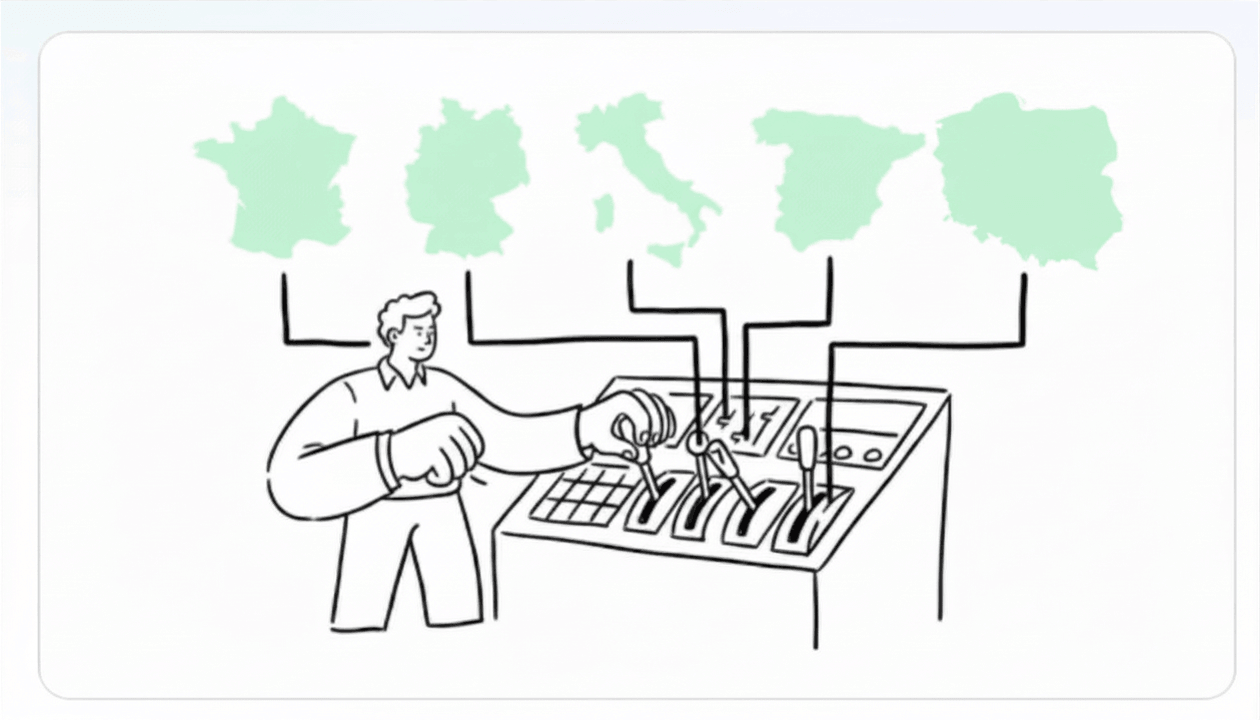

The first time you run acquisition campaigns across multiple markets simultaneously, something becomes very clear, very quickly: what works in one market doesn’t automatically work in another. The messaging needs adjusting. The timing changes. The channels perform differently. What looks like a unified campaign from the spreadsheet is actually five parallel experiments with five different customer populations.
That was my reality at HelloPrint, where I managed lifecycle and CRM programs across several European markets in the print industry. Each market had its own purchasing behaviour, its own seasonal patterns, its own relationship with promotional pricing. And each one ruthlessly exposed the parts of our post-acquisition lifecycle that weren’t working.
That experience reshaped how I think about acquisition entirely — because the multi-market context forced a discipline that single-market programs often skip: connecting what happens before the first purchase directly to what happens after it.
The amplification effect
Brian Balfour, founder of Reforge and former VP of Growth at HubSpot, describes retention as the foundation that all other growth sits on: “If your retention is poor, nothing else matters. All the acquisition in the world won’t save a leaky bucket.”
In a single market, a leaky bucket is annoying. Across multiple markets, it’s catastrophic — because you’re simultaneously running acquisition in five places with five different unit economics, and the leaks compound. A retention problem that’s “manageable” in one market becomes a structural threat when replicated across several.
What I found at HelloPrint is that multi-market acquisition doesn’t just scale the customer volume — it scales every weakness in your lifecycle. The markets that performed best on acquisition didn’t always perform best on retention. And the gap between CPL and actual customer value was widest in the markets where we’d optimised hardest for volume.
That forced a shift in how we evaluated campaign performance. CPL was a starting metric, not a success metric. We started asking different questions.
The four questions that changed our acquisition approach
1. Are we acquiring the right customers for the lifecycle we can deliver?
This sounds obvious. It wasn’t. We had campaigns performing beautifully on acquisition KPIs — high volumes, low cost per lead, strong conversion rates — that were producing cohorts with terrible retention. When we dug into why, the answer was usually mismatch: the campaign had attracted customers whose expectations didn’t align with the product experience we could deliver in that market at that time.
In print e-commerce, where delivery timelines, product quality, and customer support capabilities varied by country, this mattered enormously. A campaign promising speed in a market where logistics weren’t yet optimised created customers primed to be disappointed. The acquisition team hit their numbers. The lifecycle team inherited the problem.
The fix was simple but required organisational alignment: lifecycle data — specifically 30-day and 90-day retention by acquisition cohort and channel — had to flow back into acquisition planning. Not as a blame mechanism, but as a calibration tool. Which campaigns were producing customers who stayed? What did those customers look like? How do we find more of them?
2. What does first-purchase behaviour tell us about long-term value?
Across markets, we noticed significant variation in first-purchase patterns. Customers who placed a larger, more considered first order tended to retain at much higher rates than customers acquired through promotional offers for small initial purchases. The promotional customers were cheaper to acquire. They were significantly more expensive to retain — and many didn’t stay at all.
This led to a change in how we structured promotional campaigns. Rather than discounting the first purchase broadly, we tested offers that incentivised a more considered first engagement — slightly higher initial order values that signalled stronger intent. Acquisition volume dipped. Customer value over 12 months improved meaningfully.
Seth Godin captures the underlying principle: “Don’t find customers for your products. Find products for your customers.” In acquisition terms: don’t find customers who will take the cheapest deal. Find customers who are a genuine fit for what you deliver.
3. How does post-acquisition lifecycle need to adapt by market?
The most interesting lesson from managing multiple markets is that the lifecycle program can’t be a direct translation of one market’s playbook. The first-purchase email that works in one country needs adjustment — in language, tone, timing, and content — for another. Cultural norms around promotional communication vary significantly. What feels like a helpful follow-up in one market feels aggressive in another.
We learned this the expensive way. Applying the same email cadence from our highest-performing market to a new one produced unsubscribe rates that took months to recover from. The message wasn’t wrong. The cultural fit was.
If you’re operating across markets — or planning to — build localisation into your lifecycle program from the start, not as an afterthought. This doesn’t just mean translation. It means understanding the customer’s relationship with email communication, their purchase decision timeline, and their expectations of post-purchase contact in that specific context.
4. Which acquisition channels produce the best lifecycle outcomes by market?
The channel mix that drives the highest volume in a market is rarely the same as the channel mix that drives the highest lifetime value. In some markets, paid search produced high-intent customers who converted quickly and stayed. In others, the same channel brought in discount-seekers who churned after one order.
Mapping channel performance to lifecycle outcomes by market gave us a genuinely different picture of where to invest. It also surfaced counterintuitive findings: some lower-volume, higher-effort channels (content marketing, referral programs) were producing the highest-retention cohorts in specific markets, despite being underrepresented in the budget because their CPL looked less attractive in isolation.
What this means for single-market programs
You don’t need to be operating across multiple countries for this thinking to be useful. The multi-market context just makes the lessons impossible to ignore.
For any acquisition program, the core question is the same: what happens to these customers after we acquire them, and are we building acquisition strategies that reflect that?
Connecting acquisition to lifecycle data — even in a basic way, even with a 90-day retention view by channel — changes the quality of decisions you make at the top of the funnel. It’s also one of the most powerful ways a lifecycle marketer can add value to an acquisition team: not by taking over the metrics, but by bringing the downstream picture into the conversation.
Andrew Chen, writing on growth strategy, puts it plainly: “The best growth teams obsess over retention, not acquisition. Because retention is what makes acquisition efficient.”
That’s the lesson multi-market scaling taught me in the most direct way possible. Acquisition is only as good as the lifecycle it feeds.
The practical starting point
If you’re not currently connecting acquisition data to lifecycle outcomes, here’s the minimum viable version to start with:
Pull your last six months of new customers, segmented by acquisition channel or campaign. For each segment, calculate your 30-day and 90-day retention rate, and your average order value or first-30-day revenue. Plot it against CPL or CAC for each segment.
The picture that emerges will almost certainly change how you think about budget allocation. Some of your “best” channels will look less impressive. Some underinvested ones will look much more valuable. That gap between how you’re allocating spend and where the value is actually coming from — that’s your roadmap.