
The 14-day free trial is one of the most standard constructs in SaaS and subscription products. It’s also one of the most poorly executed lifecycle moments in most companies. Teams spend enormous resources on the campaign that drives the trial signup, then hand the experience off to a generic onboarding sequence and hope the product sells itself.
It usually doesn’t.
The trial window is the highest-stakes period in your entire lifecycle. The user is evaluating you with active intent. They’ve given you their email address, their time, and a genuine shot. What you do with those 14 days — how you guide them, what you show them, when you ask for the sale — determines conversion rates more than your pricing, your features, or your brand.
This is a day-by-day framework for turning more of those trials into paid customers. Not through pressure, but through deliberate, well-timed value delivery.
The foundational principle: experience before ask
Wes Bush, author of Product-Led Growth, argues that the trial period should prioritise one thing above all else: “Help users experience the value of your product before asking them to pay for it.” It sounds obvious. Most trial sequences violate it — they make the ask too early, before the user has had a genuine value moment.
The ask earns its right to be heard only after the user has experienced something worth paying for. Everything before that moment is an investment. Everything after it is harvest.
Keep this principle in front of you for the entire 14 days.
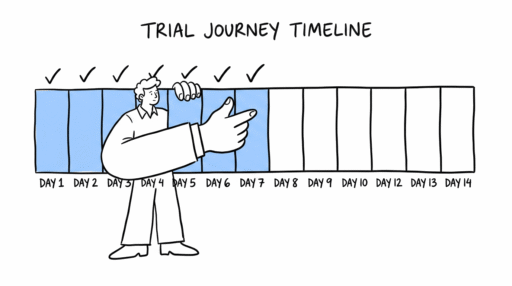
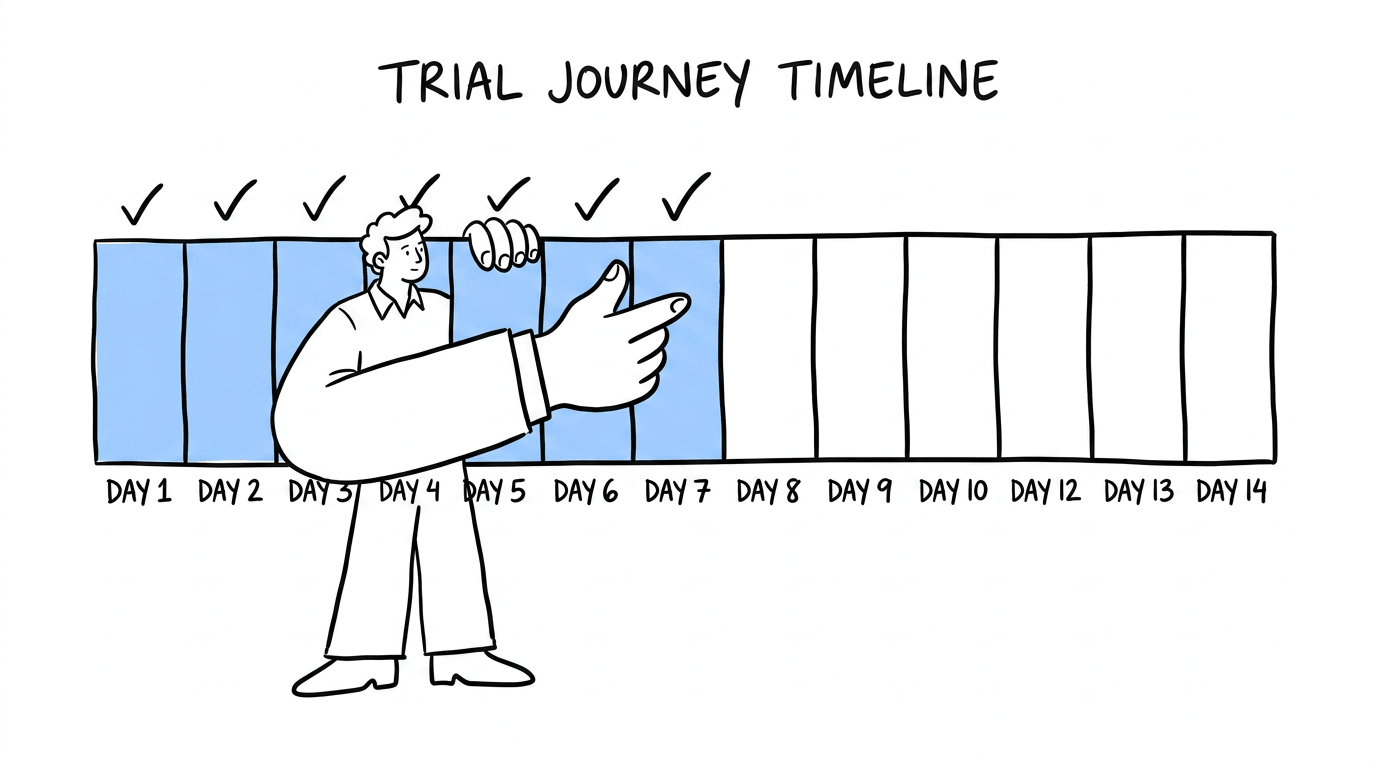
Days 1–3: The critical window
Research consistently shows that trial users who don’t take a meaningful action in the first 72 hours rarely convert. This window is your entire activation challenge compressed into three days.
Day 0 — The welcome (immediate)
Send within minutes of signup. This email has one job: get the user to take their first meaningful action in the product.
Not a list of features. Not a video tour of everything you offer. One clear action, with a direct link that takes them there.
Subject line: make it imperative and specific. “Your first step: create your [core object]” outperforms “Welcome to [Product]!” consistently. The subject line is a commitment device — it tells the user exactly what they’re doing next.
In-app: the moment they log in, guide them to that same first action. The email and the in-app experience should speak with one voice.
Day 1 — The check-in (24 hours, behaviorally branched)
This is your first behavioral branch. Look at what the user did.
If they completed the activation action: Congratulate them briefly, show them a small result or proof that something worked, and introduce the next natural step. Don’t overwhelm — one next step only.
If they didn’t activate: Don’t resend the same message. Try a different format or angle. If Day 0 was instructional, try social proof: “Most [job title/persona] find they get their first [result] within about 20 minutes — here’s what that looks like.”
Day 3 — The value check
By Day 3, you can start to identify which users are genuinely engaged and which are fading. Send a message focused entirely on value — not features, not a pitch, just evidence of what engaged users are getting.
A specific, concrete result works best: “[Customer type] using [product] for [use case] typically see [metric] improve within the first week.”
“Make it simple. Make it memorable. Make it inviting to look at. Make it fun to read.” — Leo Burnett
The Day 3 email should pass that test. If it’s long, cut it. If it’s vague, sharpen it.
Days 4–7: Deepening engagement
The first week is about activation. The second half of the first week is about habit formation — getting the user to return and go deeper.
Day 5 — The feature discovery
By now, activated users are ready for their second layer. Introduce one feature that builds on what they’ve already done — not a random capability, but the natural next step in their journey.
Frame it as a discovery: “Now that you’ve [done X], here’s something most users find even more useful.” The word “most” does quiet work here — it creates social proof without being explicit about it.
For non-activated users, Day 5 is your last low-friction shot. Try a direct, personal-sounding email: “I wanted to check in personally — did you run into any trouble getting started? If anything felt confusing, I’m happy to help.” This message, even when automated, converts at meaningfully higher rates than promotional messaging for this segment because it’s positioned as help, not sales.
Day 7 — The midpoint check
Seven days in is a natural milestone. Use it as a prompt to surface progress — what the user has done, what it’s added up to, what’s possible in the remaining seven days.
Des Traynor, co-founder of Intercom, has described customer communication as a series of conversations at the moments that matter. “Every interaction is an opportunity to either deepen the relationship or damage it.” The Day 7 email is a relationship deepener — it shows you’re paying attention to their specific journey, not just sending a sequence.
Segmented by engagement: highly active users get a summary of what they’ve accomplished and a preview of premium features they haven’t explored yet. Lightly engaged users get a simplified version of the same, with a CTA focused on coming back to complete one specific thing.
Days 8–12: The conversion window
In the second week, the conversion becomes the explicit goal. The user has had enough time to evaluate. Now your messaging needs to make the case clearly.
Day 9 — The value summary
Before you make any ask, summarise the value the user has already received. What did they do? What does that represent? What would they lose if they didn’t convert?
This isn’t manipulative — it’s clarifying. Users often don’t consciously register the value they’ve accumulated during a trial. Helping them see it explicitly is a service, not a tactic.
Day 11 — The direct ask
You’ve earned it. Ask clearly.
Not “Don’t let your trial expire!” — that’s pressure framing and it underperforms. Instead: “You’ve [done X, Y, Z] in your trial — continuing is straightforward. Here’s how to get started with [appropriate plan].”
Include a direct link to the most relevant plan, not a pricing page where they have to make another choice. If you know enough about their usage to recommend a specific tier, do it. “Based on how you’ve been using [product], [Plan Name] is probably the right fit.”
Day 12 — The objection handler
Not everyone who hasn’t converted by Day 12 is uninterested. Some have questions. Some have hesitations they haven’t voiced. Send a message that anticipates the most common objections:
“A few things people often wonder about before upgrading: [Answer 1]. [Answer 2]. [Answer 3]. If there’s something else on your mind, reply to this email.”
“The aim of marketing is to make selling superfluous.”
— Peter Drucker
A good objection handler makes the conversion feel natural, not pushed.
Days 13–14: The urgency window
Day 13 — The honest countdown
Urgency that’s manufactured feels false. Urgency that’s real is legitimate to use. The trial ending is real.
“Your trial ends tomorrow. Here’s what you’d be keeping access to — and here’s what you’d be giving up.”
List it concretely. Not features — outcomes. Not “access to automations” but “the automations you’ve already built.” Loss aversion is real, and referencing specific things the user has created or configured is far more effective than a generic feature list.
Day 14 — The final email
Short. Direct. One CTA.
“Your trial ends today. [Button: Keep your access].”
That’s it. No story. No feature list. They know what they’re deciding. Respect their intelligence and their time.
After the trial: two segments, two paths
Once the trial ends, you have two groups: converters and non-converters.
For converters: the lifecycle continues into onboarding-as-a-customer. The first 30 days post-conversion are critical for building the habits that drive long-term retention. Don’t let the quality of communication drop the moment they pay.
For non-converters: don’t immediately suppress. Move them into a win-back track at 30 and 60 days. People who tried your product but didn’t convert are often the warmest leads you have — they just weren’t ready or confident enough at the time. Circumstances change.
The number to track
Trial-to-paid conversion rate is the headline metric, but it obscures important nuance. Track it by activation status: what’s the conversion rate of users who activated during the trial versus users who didn’t? In most products, this gap is significant — often 3x or more.
That gap tells you where the leverage is. Improving trial conversion starts with improving activation, not with better Day 13 urgency emails.