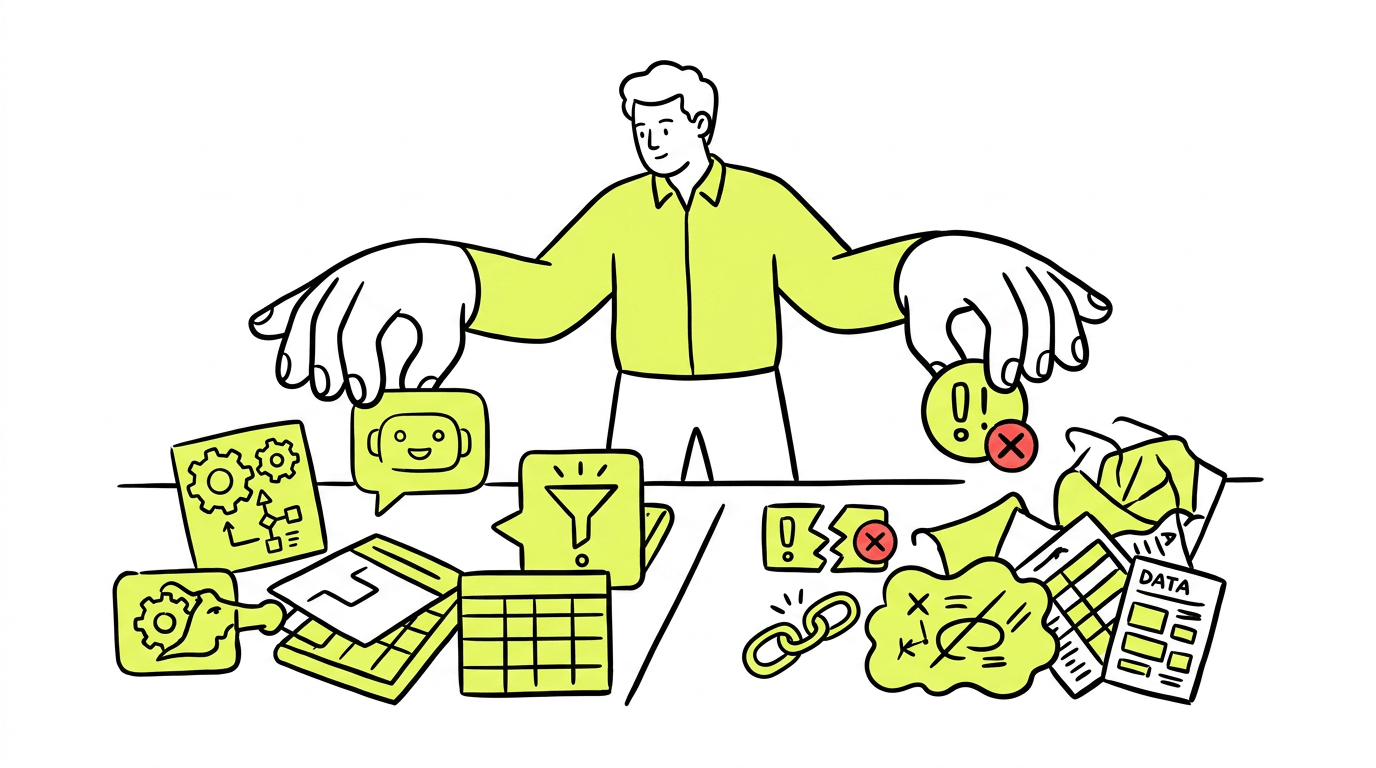

There are two kinds of AI conversations happening in marketing right now. The first is the breathless, everything-is-changing kind — vendors adding “AI-powered” to existing features and calling it a revolution, conferences with AI in every session title, LinkedIn posts about how ChatGPT will replace your team. The second is quieter and more practical: marketers actually using specific tools for specific tasks and finding that some of them are genuinely useful and some of them aren’t.
This article is firmly in the second category.
After almost a year of testing, integrating, and in some cases abandoning various AI tools across the lifecycle stack, I have a much clearer picture of where the technology is earning its place and where it’s adding complexity without adding value. The honest answer is that AI is useful for lifecycle marketing — just not in all the ways that are being marketed.
The right frame: AI as a multiplier, not a replacement
Before getting into specific tools, it’s worth establishing the frame that’s proven most useful in practice.
“The key question isn’t what AI can replace — it’s what it can amplify.” — Reid Hoffman, co-founder of LinkedIn
Lifecycle marketing is fundamentally a human discipline. It’s about understanding why real people behave the way they do, and designing experiences that move them toward outcomes that are good for both them and the business. AI doesn’t change that fundamental challenge. What it does is accelerate and scale the execution of strategies that are still human-designed.
The lifecycle marketers getting the most from AI right now are using it as a multiplier on work they already know how to do well — not as a substitute for the strategic thinking that underpins the work.
With that frame in place, here’s what’s actually worth paying attention to.
Where AI is genuinely useful in the lifecycle stack
1. Copywriting and content generation
This is the most accessible entry point, and for good reason — it’s where AI delivers the most immediate, tangible productivity improvement.
For lifecycle marketing specifically, the use cases that work well:
Email subject line generation. Given a goal, an audience, and a tone, AI tools (Claude, GPT-4, and others) can generate 10–20 subject line variants in seconds. The quality is variable, but the sheer volume of options makes it easy to identify strong candidates and test them systematically. What previously took 30 minutes of iteration now takes 5.
First draft generation for lifecycle emails. AI drafts for onboarding emails, win-back campaigns, and feature announcements are genuinely useful starting points. They’re rarely ready to publish without human editing — the voice is often too generic, the specifics are too vague — but they eliminate the blank page problem and compress the drafting process significantly.
A/B test variant creation. When you’re running an experiment and need 3-4 distinct variants of the same message, AI can generate them quickly with different angles, tones, and structures. This makes it practical to test more variables more frequently.
Ann Handley, author of Everybody Writes, has observed that “good content isn’t about good storytelling. It’s about telling a true story well.” AI can help you tell it faster. It can’t tell it for you — the truth of your customers’ experience, your brand voice, and your specific value proposition still has to come from you.
2. Segmentation and audience analysis
AI-assisted segmentation is where the technology starts to separate the genuinely advanced teams from the rest.
Traditional segmentation involves a marketing analyst writing queries against your CRM or data warehouse, pulling cohorts based on criteria a human defined. It works, but it’s slow, it’s limited by the analyst’s hypotheses, and it doesn’t surface patterns that nobody thought to look for.
AI-assisted segmentation tools — built into platforms like Braze, Klaviyo, and several data warehouse tools — can analyse behavioral patterns across your customer base and identify segments that perform differently without being told what to look for. The “high-purchase-frequency but low-engagement” segment. The “recently-activated but feature-shallow” cohort. Patterns that would take days to identify manually can surface in hours.
The prerequisite — as always with AI in lifecycle — is clean, consistent data. The more fragmented your event tracking, the less useful these tools are.
3. Personalisation at scale
Personalisation has always been limited by the ratio of content volume to audience size. Writing truly personalised emails for thousands of customers isn’t humanly possible. AI changes that ratio significantly.
Dynamic content generation — where AI produces personalised email content based on each recipient’s behaviour, preferences, and profile — is moving from an enterprise-only capability to something accessible to mid-market teams. Tools like Persado and Phrasee use AI to personalise not just the content but the emotional register and language style of messages based on individual response patterns.
The results, when the underlying data is strong, are measurable. Open rates and click rates improve — not dramatically, but consistently — because the message feels more relevant to the individual.
4. Predictive analytics and churn scoring
Covered in more detail in Article 13, but worth noting here as part of the broader AI stack: churn prediction models are now accessible through standard CRM and lifecycle platforms without requiring a dedicated data science team.
HubSpot, Salesforce, and several specialist tools offer AI-powered churn scoring that updates dynamically based on behavioral signals. The output is a risk tier for each customer, which can be used to trigger targeted retention interventions. It’s not magic — the same caveats about data quality apply — but it’s significantly more sophisticated than the rule-based triggers most teams were running three years ago.
Where AI is not yet worth the investment
Fully automated campaign management
The vision of an AI system that autonomously designs, writes, segments, sends, and optimises your lifecycle campaigns without human oversight is further away than most vendors imply. The tools that claim to do this tend to produce results that are mediocre and homogeneous — optimised for average performance rather than for the specific nuances of your brand, your customers, and your business context.
Human judgment on campaign strategy, creative direction, and audience understanding remains essential. AI can execute faster and test more variants, but the strategic layer still needs a person in the loop.
Replacing qualitative customer research
AI is good at finding patterns in data. It’s not good at understanding the why behind those patterns. Customer interviews, support ticket analysis, cancellation surveys — the qualitative inputs that tell you what’s actually driving behaviour — cannot be replaced by AI analysis of behavioral data alone.
“The most important thing in communication is hearing what isn’t said.” — Peter Drucker
AI hears what is said, in aggregate. The things that aren’t said — the frustrations customers never articulate, the needs they can’t quite express — still require human ears.
A practical integration approach
Rather than trying to implement AI across your entire lifecycle stack at once, here’s a phased approach that builds capability without overwhelming your team:
Phase 1 — Copywriting assistance. Start using AI for subject line variants and first-draft email copy. Build internal guidelines for how to brief the AI (what context to provide, what to always review before publishing) and establish quality standards.
Phase 2 — Segmentation enhancement. Connect AI-assisted segmentation to your highest-priority lifecycle programs. Start with one — churn prediction or trial conversion — and measure the lift before expanding.
Phase 3 — Personalisation at scale. Once your data infrastructure supports it, introduce dynamic content personalisation for your highest-volume communications. Measure the impact on engagement rates and downstream conversion.
Phase 4 — Predictive intervention. Build automated triggers around AI-generated risk scores, with human-designed interventions for each risk tier.
Each phase builds on the one before it. Teams that try to jump to Phase 4 without the foundations in place typically get disappointing results and conclude that AI doesn’t work in lifecycle — when the real problem is sequencing.
The capability that will matter most
As AI tools become more capable and more widely adopted, the lifecycle marketers who stand out won’t be the ones who use the most AI — they’ll be the ones who combine AI execution with the deepest understanding of their customers.
The strategic thinking, the empathy for what customers actually experience, the judgment about what a message should feel like at a critical moment in the relationship — these remain distinctly human capabilities. AI makes them faster to execute. It doesn’t make them less important.
If anything, as the execution layer becomes more automated, the thinking layer becomes more valuable. That’s a good development for lifecycle marketers who have invested in genuine customer understanding.