
Your best customers are right there in your database. They’ve been active for months, they consistently engage with your product, and if you asked them in a survey, they’d say they’re satisfied.
And yet, most of them will never recommend you to anyone. They’ll never write a review, share your content, or refer a colleague. They’re happy, but they’re passive.
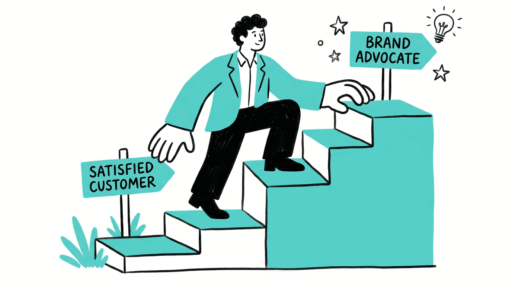
This is the loyalty gap — the space between a satisfied customer and an active advocate. And it’s the most under-explored growth opportunity in lifecycle marketing.
Why satisfaction is not enough
The marketing industry has spent decades conflating satisfaction with loyalty. NPS scores are treated as gospel, and a score above 50 is celebrated as proof that customers love you.
But satisfaction is just the absence of dissatisfaction. A satisfied customer doesn’t leave — but they also don’t promote. They’re neutral. They’ll stay until something slightly better or slightly cheaper comes along, and then they’ll leave without guilt because they never felt genuinely connected to your brand.
Real advocacy requires something beyond satisfaction. It requires a moment where the customer feels like your product or your brand genuinely changed their outcome — not just met their expectations, but exceeded them in a way that felt personal.
Those moments don’t happen by accident. They’re designed.
The advocacy ladder
I think about the journey from satisfied customer to active advocate as a four-step ladder. Each step requires a different trigger and a different strategy.
Step 1: Satisfied → Engaged. The customer is happy with the product but passive. They use it, but they don’t think about it. To move them to engaged, you need to create moments of surprise and delight that break the routine. This could be a personalized insight they didn’t expect, a proactive suggestion that saves them time, or recognition of a milestone they didn’t know they’d reached.
Step 2: Engaged → Loyal. The customer is now actively involved — they explore features, they respond to communications, they care about the product beyond basic utility. To move them to loyal, you need to make switching costly in a positive way. Not through lock-in or friction, but through accumulated value — their data, their history, their customizations, their relationships within the platform. Loyalty is built when leaving would mean losing something personal.
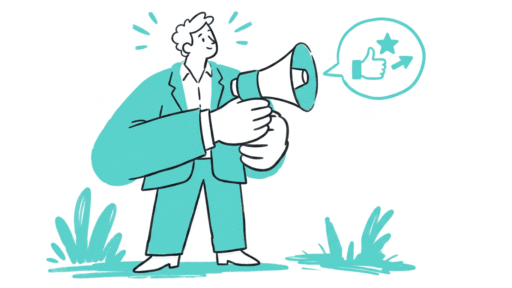
Step 3: Loyal → Advocate. The customer wouldn’t leave even if a competitor offered a better price. But they still don’t actively recommend you. To move them to advocate, you need to give them a reason to share that goes beyond your product. People don’t recommend tools. They recommend results. Give them a story worth telling: “I used to spend four hours on this, now it takes twenty minutes” is something people want to share because it makes them look smart, not because it makes you look good.
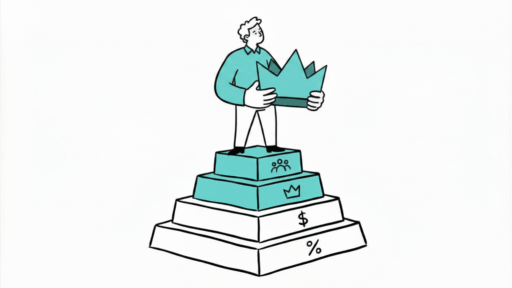
Step 4: Advocate → Ambassador. The customer actively promotes you without being asked. They create content, they answer questions in communities, they refer colleagues. This level is rare and can’t be manufactured — but it can be facilitated. Recognize these people. Give them early access, involve them in product decisions, create a space where they belong to something bigger than a customer base.
Practical strategies for each step
Let me get specific about what you can actually implement.
Satisfied → Engaged: Surprise with value
Design automated moments of unexpected value for customers who have been consistently active for 60-90 days.
Send them a personalized performance report they didn’t ask for. Show them how their usage compares to similar accounts (people love benchmarks). Recommend a feature they haven’t tried that directly relates to their usage pattern. Surface a result they achieved but might not have noticed: “You processed 1,200 orders this quarter — that’s 40% more than last quarter.”
The key is that these should feel like gifts, not marketing. No CTA, no upsell, no “upgrade to see more.” Just pure value, delivered when they least expect it.
Engaged → Loyal: Build accumulated value
Create features and experiences that grow more valuable with time and use.
Custom dashboards, saved reports, historical data, templates they’ve built, integrations they’ve configured — all of these create what I call positive switching costs. The customer stays not because leaving is hard, but because staying is rich.
On the communication side, this is where personalization pays the highest dividends. An email that says “Based on your 8 months of campaign data, here are three patterns we noticed” is infinitely more powerful than “Check out our new feature.” The first leverages their history with you. The second could be sent to anyone.
Loyal → Advocate: Make them the hero
Give loyal customers tools and stories that make them look good when they share.
Create shareable results. Year-in-review reports, milestone celebrations, performance badges — anything the customer would be proud to post on LinkedIn or share with their team. The mechanic is simple: if sharing your product makes the customer look competent, successful, or innovative, they’ll do it voluntarily.
Ask at the right moment. Timing a review or referral request is everything. Don’t ask when they’ve just signed up (they have no experience to share). Don’t ask at random (it feels extractive). Ask immediately after a positive outcome — a successful campaign, a milestone reached, a problem solved. That’s when they’re most naturally inclined to share.
Make referral effortless. Every extra click in a referral flow cuts participation in half. One link, one message, done. Pre-write the referral message but make it editable so it doesn’t feel robotic.
Advocate → Ambassador: Create belonging
This step only works for your top 1-5% of customers, and it’s not scalable by design. But for those few, the impact is disproportionate.
Create an exclusive community or advisory group. Invite them to product beta programs. Feature them in case studies or on your blog. Give them a direct line to your product team. These aren’t perks — they’re signals that you see them as partners, not users.
The best ambassador programs don’t feel like programs at all. They feel like relationships.
Measuring the loyalty gap
Most teams only measure the extremes — satisfaction (NPS) and referrals (referral program metrics). But the interesting data lives in the middle.
Engagement depth. Beyond login frequency, track how many features or areas of your product a customer uses. Shallow usage (one feature, same workflow every time) indicates satisfaction without engagement. Deep usage indicates someone who’s invested.
Organic sharing rate. How often do customers share your content, mention your brand, or link to your product without being asked or incentivized? This is the purest measure of advocacy.
Time to first recommendation. For customers who eventually refer someone, how long did it take from signup to first referral? This tells you when in the lifecycle the advocacy switch flips — and helps you design triggers around that moment.
Expansion rate. Customers who upgrade, buy more, or expand their usage are showing loyalty through their wallets. Track this segmented by customer tenure and engagement level to find the intersection where growth happens.
The uncomfortable math
Here’s why the loyalty gap matters financially. Acquiring a new customer costs 5 to 25 times more than retaining one. But a referred customer costs almost nothing to acquire and retains at 2-4 times the rate of a paid-acquired customer.
Every time a satisfied customer doesn’t become an advocate, you’re leaving this compounding loop on the table. You’re spending money to acquire new customers while sitting on a database of existing customers who could do it for free — and deliver higher-quality leads while doing it.
Closing the loyalty gap isn’t a “nice to have” growth strategy. It’s the most capital-efficient growth strategy available to any business with an existing customer base.
Start measuring it. Start designing for it. And stop assuming that keeping customers happy is the same thing as turning them into your growth engine.